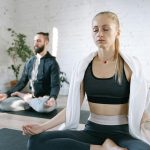
There is a quiet moment at the beginning of a yoga practice when nothing has yet happened.
The mat is unrolled. The body stands or sits. The breath moves in and out, perhaps shallow at first, perhaps hurried from the day that came before. And then, almost imperceptibly, attention turns inward.
This turning inward is where yoga truly begins.
The word “yoga” derives from the Sanskrit root yuj, meaning to yoke, to unite, to bring into integration. Long before it became a fitness class or an aesthetic on social media, yoga was a spiritual discipline — a pathway toward union between body and mind, breath and awareness, individual and universal consciousness. It was never solely about flexibility; it was about remembering wholeness.
In modern life, fragmentation has become normal. We live in our thoughts while neglecting our bodies. We override fatigue. We suppress emotion. We speak kindly to others while speaking harshly to ourselves. Yoga offers something quietly radical in response to this fragmentation: integration.
It asks us to inhabit ourselves fully.
From a physiological perspective, yoga is profoundly regulating. Slow, conscious breathing stimulates the vagus nerve, enhancing parasympathetic tone and reducing sympathetic arousal. Heart rate slows. Blood pressure stabilises. Cortisol levels decrease. The body shifts from a state of defence to one of restoration. In a culture saturated with stimulation, this shift is not trivial; it is reparative.
Yet the benefits of yoga are not confined to nervous system regulation. The practice also restores proprioception and interoception — our ability to sense where we are in space and what we are feeling internally. Trauma, chronic stress and even prolonged digital immersion can diminish these sensory capacities. We become disconnected from subtle bodily cues. We notice hunger only when ravenous, fatigue only when depleted, emotion only when overwhelmed.
Yoga re-educates awareness.
When we hold a posture and observe sensation without immediate reaction, we strengthen the neural pathways associated with mindful attention. The prefrontal cortex engages in dialogue with the limbic system. Reactivity softens. Choice expands. We begin to experience discomfort without interpreting it as threat. This has profound implications not only for physical endurance but for emotional resilience.
On a deeper spiritual level, yoga invites us into relationship with the breath as life force. In yogic philosophy, breath is not merely oxygen exchange; it is prana — vital energy. Whether one interprets prana metaphorically or metaphysically, the experiential reality is powerful. Conscious breathing alters state. It anchors awareness in the present moment. It bridges the tangible and the intangible.
Breath is both voluntary and involuntary. It mirrors the interplay between control and surrender that defines much of human experience. In yoga, we learn when to engage and when to soften. We learn that effort without release creates strain, and release without engagement creates collapse. This balance — known as sthira (steadiness) and sukha (ease) — is at the heart of sustainable strength.
Many individuals come to yoga seeking physical benefits: increased flexibility, improved posture, reduced pain. These are real and well-documented. Regular practice enhances muscular balance, joint stability and circulation. It supports spinal health. It improves balance and coordination, which are protective across the lifespan. Yet for many practitioners, something unexpected unfolds. Beneath the stretching and strengthening, an emotional landscape begins to reveal itself.
The body holds memory.
Not only cognitive memory, but somatic imprints of lived experience. Shoulders that habitually rise may reflect vigilance. Tight hips may echo stored stress. A guarded chest may mirror self-protection. As we move slowly and intentionally, these patterns become visible. Sensations surface. Sometimes tears appear without clear narrative. Sometimes relief arrives as warmth or trembling. Yoga provides a container where these experiences can be witnessed without judgement.
This witnessing is sacred.
In many spiritual traditions, healing begins not with fixing but with awareness. When we bring compassionate attention to what has been held silently within the body, we create space for integration. We do not force release; we allow it. The mat becomes both ground and altar a place where we meet ourselves honestly.
In the Tranquility Tribe spirit, yoga is not about performance. It is not about achieving advanced postures or proving discipline. It is about listening. Deep listening to the body’s wisdom. Listening to the rhythm of breath. Listening to the subtle guidance that arises when the noise of external expectation quiets.
In a world that constantly asks us to look outward, yoga invites inward return.
There is also a communal dimension to practice. Even when practised individually, yoga connects us to a lineage that spans thousands of years. We move through postures shaped by generations before us. We participate in an ancient dialogue between human body and universal consciousness. This sense of continuity can be profoundly grounding. It reminds us that we are part of something enduring.
Spiritually, yoga gestures toward unity beyond separation. In moments of deep presence, the distinction between observer and observed can soften. Breath moves. Body moves. Awareness rests. There is no striving, no comparison, no narrative of inadequacy. There is simply being.
For individuals navigating anxiety, this state can feel revolutionary. Anxiety thrives on anticipation on imagined futures and rehearsed scenarios. Yoga anchors awareness in immediacy. The mind cannot simultaneously track complex worry loops and attend fully to breath and sensation. Over time, this repeated anchoring rewires habitual patterns. The brain learns that safety exists in the present moment.
Depression, conversely, often involves constriction of energy, of posture, of perspective. Gentle movement, combined with breath, can gradually expand both body and mood. Research suggests that yoga increases levels of gamma-aminobutyric acid (GABA), a neurotransmitter associated with calm and mood stability. While yoga is not a replacement for clinical care where needed, it can be a powerful adjunct, supporting holistic well-being.
At its deepest level, yoga asks a spiritual question: who are you beneath your roles?
When you step onto the mat, you are not parent, partner, professional or caretaker. You are breath and awareness inhabiting form. This stripping back can feel both vulnerable and liberating. Without external identifiers, we meet the raw experience of being alive. Some days that experience feels peaceful. Other days it feels restless or resistant. Both are welcome.
This unconditional inclusion is perhaps yoga’s greatest gift. Nothing needs to be edited out. Fatigue is allowed. Joy is allowed. Grief is allowed. Strength and trembling coexist. In learning to accept the full spectrum of internal experience, we cultivate self-compassion. We soften the harsh internal critic. We begin to relate to ourselves not as projects to perfect, but as beings to honour.
The spiritual dimension of yoga does not require adherence to any particular belief system. It simply requires presence. For some, presence opens into a sense of connection with something larger, nature, divinity, universal consciousness. For others, it deepens connection to inner truth. However it is framed, the effect is similar: fragmentation reduces. Unity increases.
In a culture driven by acceleration, yoga is an act of resistance. It refuses urgency. It values depth over speed. It prioritises embodiment over appearance. It reminds us that healing is not achieved through force but through alignment.
When practiced consistently, yoga becomes less about the hour on the mat and more about how we inhabit the rest of our lives. We notice when breath shortens during conflict and consciously lengthen it. We recognise tension rising in the shoulders during stress and soften them. We become aware of inner narratives and choose gentler language. The practice extends beyond posture into relationship.
Ultimately, yoga is a remembering.
A remembering that your body is not an obstacle but a gateway. A remembering that breath carries wisdom. A remembering that strength and softness are not opposites but partners. A remembering that beneath striving and comparison, there is a steady centre that has always been there.
When you roll out your mat, you are not beginning something foreign. You are returning home.
And in that return, something sacred stirs quiet, steady, whole.